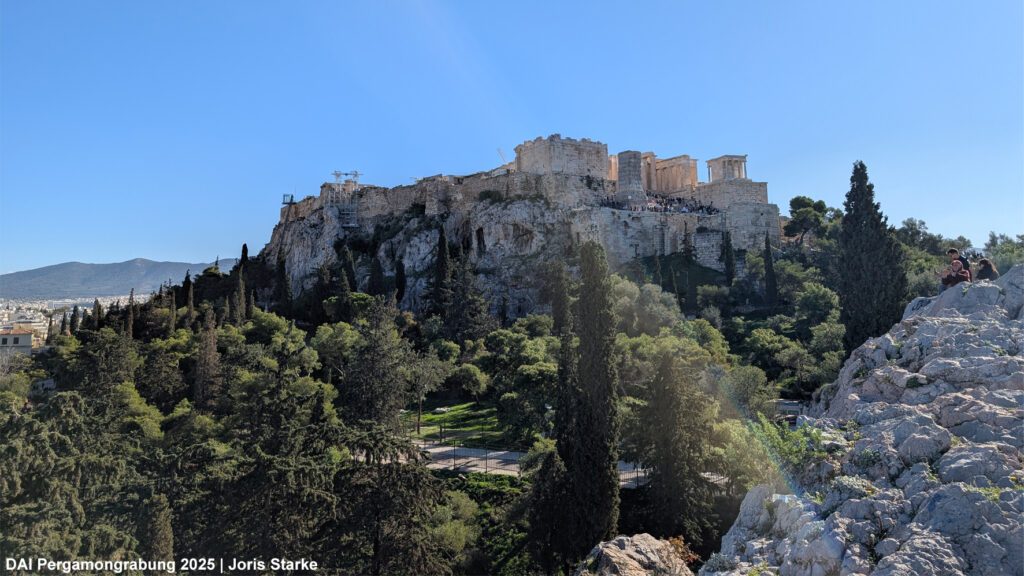
Last year’s annual meeting of the Mediterranean Geoscience Union (MedGU) took place from 10–12 November in Athens, right across the Aegean Sea from the Pergamon – a perfect opportunity to present results from the Micro-Region in a broader context and make larger-scale comparisons. Held at the National and Kapodistrian University of Athens, the 5th meeting of the MedGU featured a wide range of methodological approaches to research interests in the Mediterranean region. In order to gain insight into the broader picture of current research findings from other parts of the Mediterranean it was necessary to include the Pergamon Micro-Region.
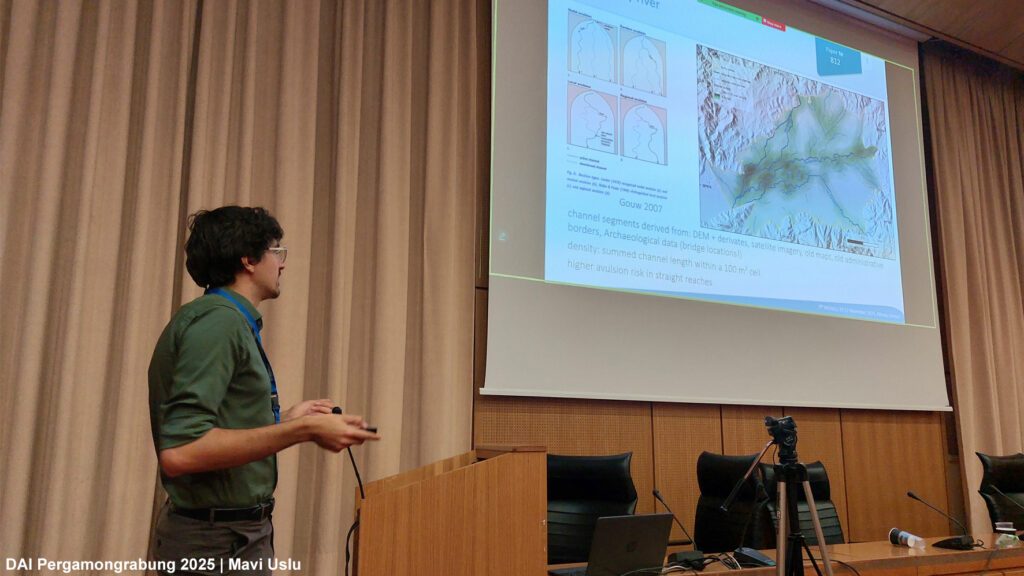
New results from the Pergamon Micro-Region were presented during Conference Track 9: Geomorphology, Geography, Soil Science, Glaciology, Geoarchaeology, Geoheritage. The paper named “Reconstructing river dynamics in the bread-basket of the ancient city of Pergamon: The palaeoenvironment of the Bakırçay plain, Türkiye” was presented by Joris Starke as part of his doctoral research. Joris featured the challenges imposed by modern human influence in the Bakırçay plain onto the reconstruction of the river behaviour and human-environment interaction in antiquity. Results show a passively meandering stream relatively high lateral stability and high sedimentation in the floodplain. This has led to the accumulation of levee structures and an increased risk of flooding in low-lying areas, situated between levees and alluvial fans. Flooding might have occurred due to avulsions, which appear to be quite common along the course of the Bakırçay, or due to overbank flow in humid seasons, of which there are still cases today. Dynamics of river position and course alteration increased in antiquity due to increased sediment transport into and sedimentation in the floodplain, caused by increased human impact within the catchment. Consequently, archaeological sites in the plain were only found in elevated areas and historic land use is described as focused on livestock farming, not fully exploiting the agricultural potential of the fertile floodplain sediments. The Paper presented was awarded the “Best Paper Award” of the Conference Track and will be featured in the conference proceedings. The abstract of the presentation can be found here, the full scientific program of MedGU25 can be found here.
New insights and possible connecting points for future work in the Pergamon Micro-Region were obtained from a multitude of other papers, regarding, for example, coastal uplift, dust sources and sinks, water-balance and management. Ideas for future work, based on methods used in other presented papers, include under-water-mapping using UAV, heavy-metal contamination measurements and thermal spring analysis. Furthermore, new contacts for future collaborations were made along the way, improving opportunities for interdisciplinary or inter-project collaboration in the future.