–
by Fabian Becker, Robert Busch, and Joris Starke
The annual TransPergMicro meeting took place on February 6 and 7 and was once again hosted by Freie Universität Berlin. Despite the icy and slippery conditions outside, participants gathered at the Engler Villa, the former director’s residence at the Berlin Botanical Garden in Berlin-Dahlem, to continue discussing the project’s interdisciplinary working package. Over the course of two days, the participants exchanged different viewpoints on the use of various resources in the Pergamon Micro-Region and planned future work, resulting in a productive workshop.
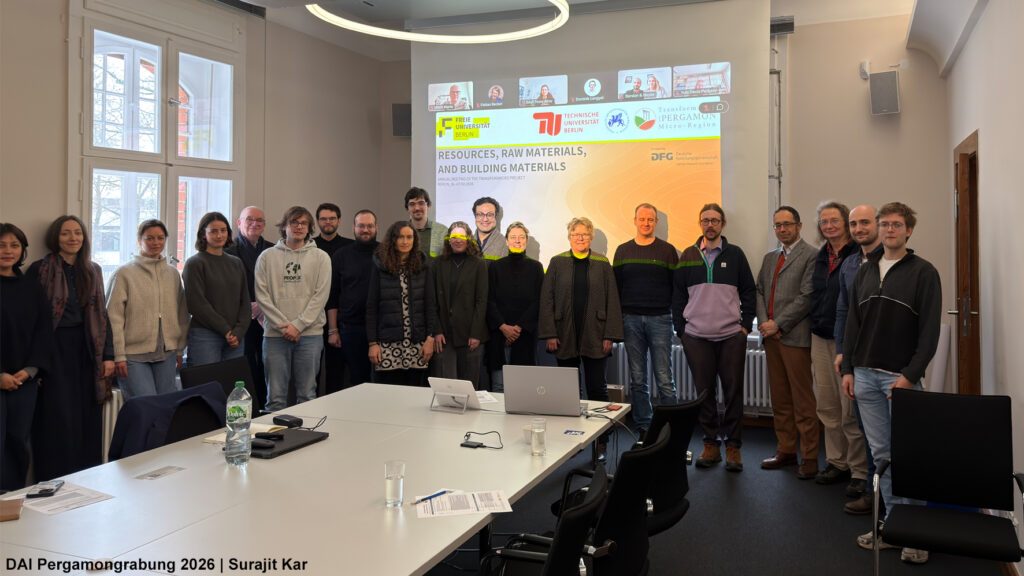
The first day was devoted to discussing resource use from the different perspectives of the groups collaborating within TransPergMicro. The day began with valuable input from project members and cooperation partners, leading to the generation of numerous new ideas on how to achieve the project’s research goals. Daniel Hinz, from the Institute of Archaeology at the University of Cologne, introduced Procedural 3D Modelling Workflows. This straightforward approach that allows for the creation of flexible 3D models of ancient buildings that can be scaled to entire city areas. For TransPergMicro, his idea of transferring visualizations of domestic buildings to quantify material volumes offers clear potential benefits for estimating the wood needed to build the city of Pergamon.
Also speaking on quantification, Felix Pirson then shifted the approach from counting buildings and their materials to estimating the number of people living in them, especially in the urban and rural areas of the Pergamon Micro-Region. Also speaking on quantification, Felix Pirson shifted the approach from counting buildings and their contents to estimating the number of people living in them, especially in urban and rural areas of the Pergamon micro-region. The team summarized current ideas and outlined future perspectives to be developed during the current funding phase of TransPergMicro by revising demographic data from paleoanthropological analyses of necropolises, historical accounts from the Pergamene writer Galen, and different approaches linking the urban fabric to population densities.
Lastly, Fabian Becker, Robert Busch, and Bernhard Ludwig explained how data from the archaeological survey and the results of the project’s geoarchaeological-geomorphological research can be interpreted together to improve our current understanding of settlement patterns in the micro-region.
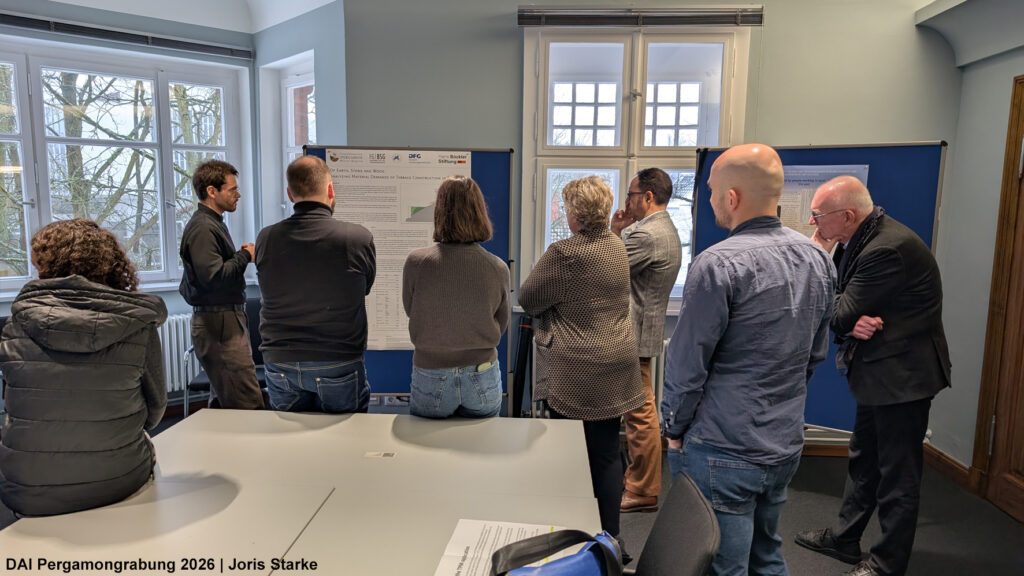
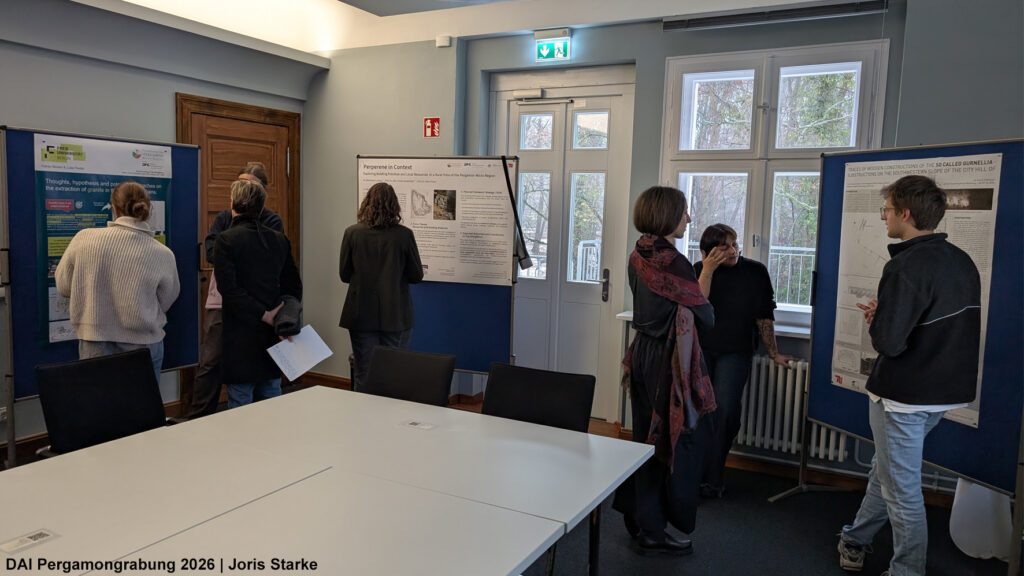
The first day of the meeting featured an open poster session at its core. This session included free presentations and discussions about different perspectives on resource use in Pergamon, particularly during the transformation of the micro-region from the Hellenistic period to the Roman Imperial period.
Topics ranged from initial hypotheses on the geological prerequisites for extracting granitic rocks in the Kozak Mountains north of Pergamon and integrating granite as a building material in the Roman Imperial networks, to fieldwork plans covering the main urban settlement in the Kozak Mountains (Perperene) and the local building material. Other topics included the costs of procuring materials and the material demands for a single building, the Palaestra of Pergamon, as well as the substructure terraces on the city hill of Pergamon. Finally, the discussion covered architectural details in the ‘Gurnellia’ of Pergamon that indicate the use of wooden beams. Thus, the topics addressed different temporal scales, as well as the gradient from the landscape level to individual buildings and their specific modes of construction.
Other posters presented a combined geochemical and landscape-scale approach to the various resources necessary for ceramic production in the micro-region, as well as a broad overview of how skeletal markers on humans excavated from ancient burials can be traced back to labour involved in the use and extraction of mineral resources. Another poster invited discussion on spatial classifications in the Pergamon Micro-Region and offered a perspective on resources from a specific geomorphological entity: rivers. Subham Mukherjee from Freie Universität Berlin, who is currently working on another DFG-funded project concerning material flows in rurban spaces (concept combining rural and urban perspectives), also contributed by highlighting valuable thematic overlaps with the Pergamon project.
On the second day of the workshop, participants engaged in an in-depth, practical exploration of TransPergMicro’s interdisciplinary Subproject 9, “Wood as a Building Material and Energy Source.” In a World Café setting, participants discussed the different working packages in small groups, focusing on details and ways to realize ideas for a model that would quantify various aspects of wood use in ancient Pergamon. While one group worked on implementing Procedural 3D Modelling Workflows in the Pergamon context, others developed an outline for a model integrating the various aspects and characteristics of wood use in Pergamon. The quantification of the Pergamene population, which was introduced during the opening talk, was addressed and further specified. Maria Tzeli, from the School of Archaeology at the University of Oxford, contributed to the model development by emphasizing the importance of wood used for roof trusses, thus broadening perspectives within TransPergMicro.
By the end of the World Café, a detailed work breakdown structure and timetable had been developed. The focus on a single subproject was very successful and may be adopted for future workshops. To maintain progress, an additional follow-up meeting for the wood subproject will be held in summer 2026.